Stand in a hedgerow in late summer and you are surrounded by working chemistry. The sloe berries going dark purple on the blackthorn, the elderberries weighing down their stems in near-black clusters, the bright red hips on the wild rose – none of that colour is decorative. It's all functional, all purposeful, all the result of millions of years of a plant trying to solve a problem. We just happened to notice it and think: that would make a lovely shirt.
How were colours made before synthetic dyes?
For most of human history, if you wanted to dye cloth a particular colour, you went outside and found a living thing that already made it. Every shade in a medieval market had a biological address. Your blue came from woad, a scraggly yellow-flowered plant whose leaves, when fermented (and the fermentation smelled absolutely appalling, enough that Elizabeth I banned woad processing within five miles of her palaces), released indigo. Your yellow came from weld, a roadside weed. Your red, if you were rich, came from kermes – a tiny scale insect scraped off Mediterranean oak trees. If you were very rich indeed, your purple came from somewhere far stranger.
Tyrian Purple
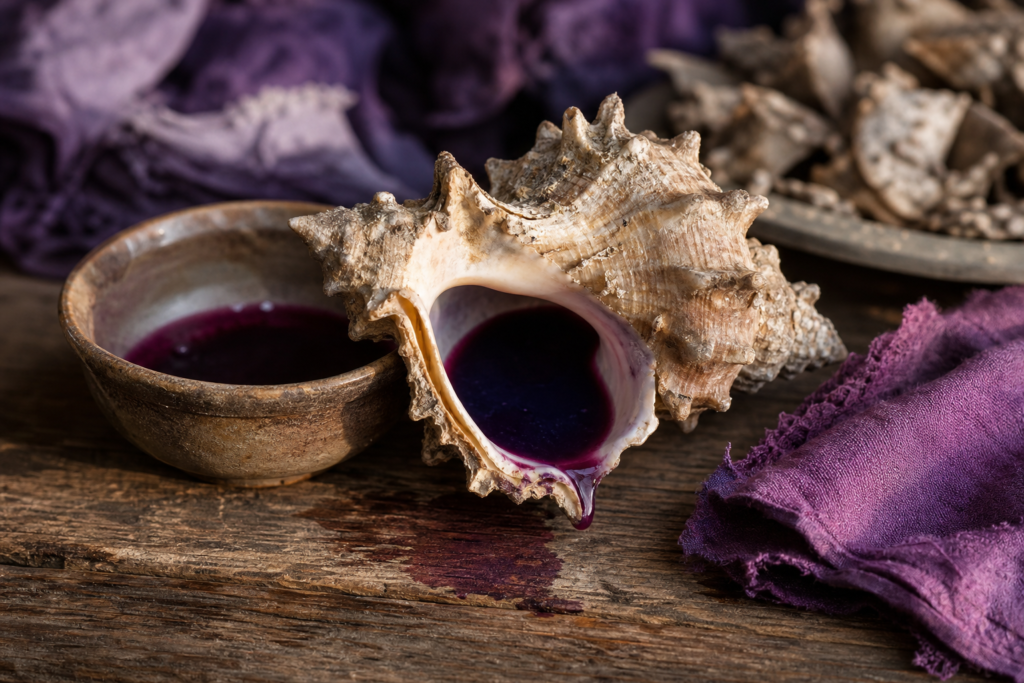
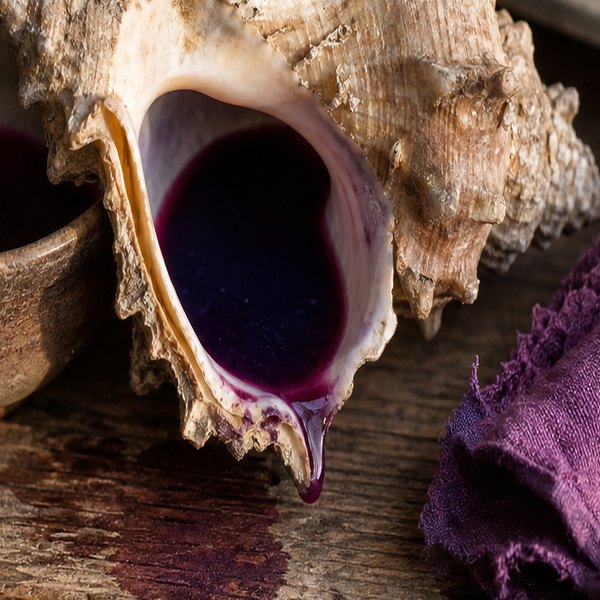
The Tyrian purple that coloured Roman emperors' robes and Byzantine court silks was extracted from the mucous gland of a sea snail, the spiny dye-murex. Each snail yielded a tiny drop. The colour itself doesn't exist in the snail as purple – it's a clear, slightly yellowish secretion that the snail uses as a chemical defence, and it only turns that famous deep red-purple when exposed to sunlight and air, through a photochemical reaction that converts the colourless compounds into a molecule called dibromoindigo. Sunlight, essentially, develops it, the way an old photograph develops in a darkroom. Something about that feels almost theatrical – the colour was always there, hidden, just waiting for the light to reveal it.
The Berry Question
The berry question is slightly different. Red and purple berries – elderberries, blackberries, sloes, rowans – get their colour from a family of pigments called anthocyanins, which are basically the plant's own pH indicators. Anthocyanins are red in acid conditions and blue-purple in more alkaline ones, which is why a sloe is blue-purple and a rowan berry is orange-red: different chemistry, different environment, different result. The point of the colour, for the plant, is to signal to birds: ripe, eat me, carry my seeds elsewhere. An advert aimed at a specific audience, and it works.
The Yellows Were Always There
The yellows in autumn leaves are always there, hidden under the green of chlorophyll all summer. When the tree withdraws its chlorophyll as the days shorten, the yellows and oranges – carotenoids, the same pigment family that makes carrots orange – are simply revealed, uncovered, as the green fades. The vivid reds of some autumn leaves (the acers, some cherries) are different: those are freshly made anthocyanins, produced as the tree breaks down its sugars before dropping the leaf. So some autumn colour is uncovering, and some is a final flourish of new chemistry. The tree isn't dying dramatically – it's just doing some very organised housekeeping.
For a different journey through the same obsession – the lengths people went to when a natural colour was rare enough to be worth chasing – The Colour That Cost More Than Gold at budgetblog.co.uk is worth a read.
What's odd, thinking back through all of this, is that the pre-industrial world had no synthetic chemistry at all. Every painter, every dyer, every person who wanted a coloured fabric was entirely dependent on the natural world being in the business of making pigments for its own completely unrelated reasons. A whelk defends itself with a gland secretion. A blackthorn attracts birds with anthocyanins. A tree manages its nutrient cycle with carotenoids. None of it was aimed at us. We just showed up with a bucket and an eye for colour and thought: we'll have that.
Hedgerows look slightly different once you know this. Less like scenery, more like a very old warehouse.
Questions this raises
- Which plants were used as natural dyes?
- Can you still dye fabric with hedgerow plants?
- Why did natural dyes fade?