Pull away from a junction in an automatic and the car just… goes. No clutch, no crunch, no stall. It feels almost too easy, which is probably why most drivers file it under "magic" and move on. But what's actually happening in there is stranger and more interesting than most people realise – because the gearbox isn't thinking at all. There's no little brain counting teeth on cogs, no digital voice saying "right, we're in third now." The whole thing runs on spinning oil, and it has done since the 1940s.
What is the fluid coupling in an automatic?
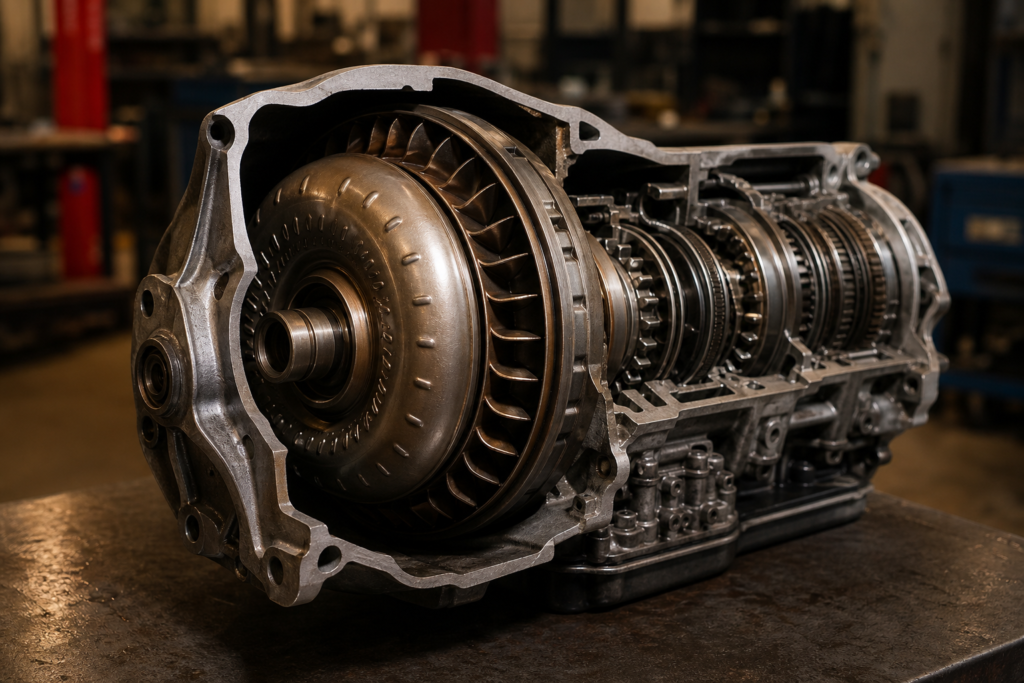
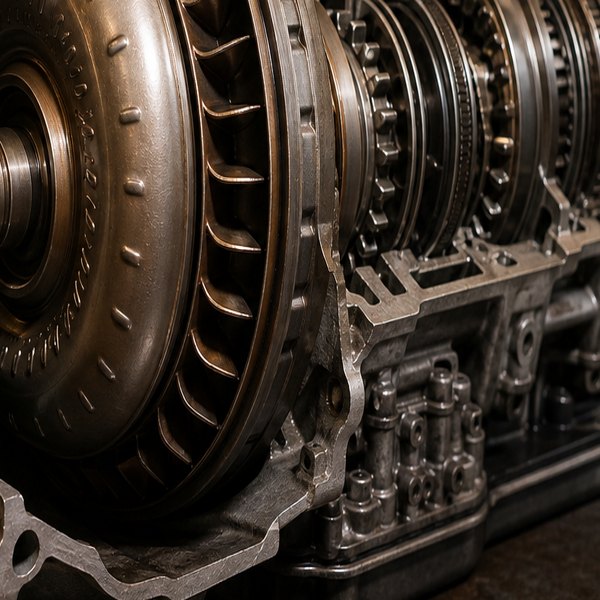
The bit that makes automatics genuinely weird is called the torque converter, and it sits between your engine and the rest of the transmission doing the job a clutch pedal does in a manual – except it never actually touches anything. Picture two desk fans facing each other. You switch one on and the moving air it creates starts turning the other one, even though the blades never meet. A torque converter does roughly that, only instead of air it uses transmission fluid spinning at enormous speed. One half is bolted to the engine, the other connected to the gearbox, and the fluid between them is the clutch – one that never wears out because it's never in contact with anything solid. The engine can be running while the wheels are completely still, and the torque converter just… slips. That's why you can sit at a red light in Drive without stalling. The oil is spinning, but it isn't transferring enough force to move you.
Why the Coupling Tightens
Once you start moving, the fluid coupling gets progressively tighter. More engine speed means more fluid velocity means more force transferred. At cruising speed most torque converters lock up almost completely – there's a small mechanical clutch inside that engages to stop the slipping and keep things efficient on the motorway. Without that lockup you'd be pouring energy into spinning oil forever, which is why early automatics were genuinely thirsty.
How does an automatic gearbox change gear?
So how does it change gear? Not by counting, and not really by following a pre-loaded programme in any meaningful sense. Traditional automatic transmissions – the torque-converter kind you'll still find in most ordinary saloons and SUVs – use a planetary gear set, which is a beautiful little mechanical arrangement where several gears orbit around a central one, all simultaneously meshed, always turning. Different ratios are selected by locking or releasing different parts of that set. And what does the locking and releasing isn't a computer sending direct commands – it's hydraulic pressure. The transmission is full of channels and valves, and fluid is routed around them based on two main signals: how fast the car is going, and how hard you're pressing the accelerator. When those two things are in tension – you're doing 40mph but you've floored it to overtake – pressure builds in a particular channel, a valve opens, a band clamps around part of the planetary set, and you've kicked down to a lower gear. No one decided. The physics decided.
Why It Feels Different to a Dual-Clutch
This is what makes the traditional automatic feel different from the modern dual-clutch gearboxes you get in a lot of hot hatches and newer cars. A dual-clutch box really is more like a computer running a programme – it has two actual clutches and knows exactly which gear it's in. The old torque-converter automatic doesn't "know" anything. It's in a constant conversation between fluid pressure and mechanical load, and the gear it's in is really just whatever state the hydraulics have settled into given current conditions. It's less a filing system and more a weather system.
Which is not to say they're imprecise. Modern torque-converter automatics have electronic controls layered over the hydraulic ones, so the two systems work together – but the fluid pressure is still doing the physical work. The electronics just help decide when to reroute it.
Next time you pull smoothly out of a junction and feel nothing except easy forward motion, remember there's hot oil spinning in a sealed chamber, transferring energy without touching itself, running through a maze of tiny valves, and quietly deciding how hard to grip a set of orbiting gears. It's one of the stranger bits of engineering you'll ever sit on top of without thinking about.
Questions this raises
- Why can't an automatic stall?
- Do automatics need different maintenance?