
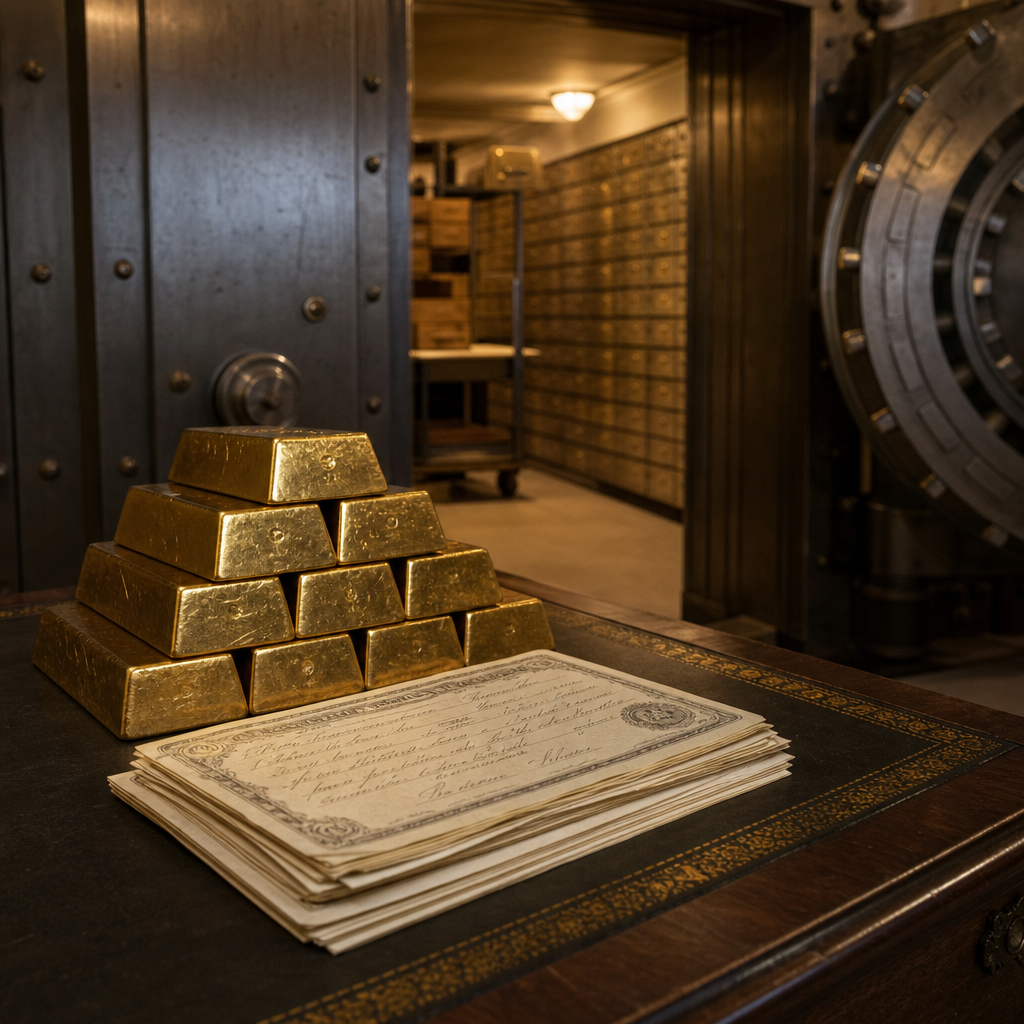
Somewhere in the City of London in the 1650s, a goldsmith made a small but world-altering decision. He had customers who left their gold with him for safekeeping, and he had other customers who needed to borrow money. Rather than move the gold around – noisy, heavy, risky – he simply wrote notes. A slip of paper saying, in effect, "the bearer of this is owed X in gold from my vault." The gold barely moved. The notes did all the travelling instead.
How did goldsmiths invent modern banking?
And here is the thing that still makes your head swim a little once you notice it: he started writing more notes than he actually had gold to cover. Not recklessly, just carefully, banking on the observation that not everyone would come and collect their gold at the same moment. He was almost certainly right. Made a tidy profit. And had – more or less accidentally – invented modern banking.
Those notes were promises. The gold they claimed was real enough, but the genius of the system, and the sleight of hand inside it, was that the note and the gold were never quite the same thing. The note was a claim. A belief. An agreement between people to behave as if the piece of paper were the thing itself.
What Your Bank Does Today
What your bank does today is the same trick, just further along the road. When you take out a mortgage, the bank does not fetch a pile of cash from a vault and hand it to you. It types a number into a computer, credits your account, and that number is quite literally created in that moment. New money, summoned from a keyboard. The house you buy was real, the stamp duty was real, the conveyancing solicitor's bill was extremely real – but the money that paid for it? The bank brought it into existence by agreeing to be owed it.
This is not a conspiracy. It is just how credit money works, and it has worked this way for a very long time. For more on the history of how money became something we believe rather than something we hold, this piece on The Colour That Cost More Than Gold is a good companion read.
Why does banking depend on confidence?
The whole system holds up because of a collective act of faith that is almost impossible to fully appreciate from the inside. The number in your current account is a promise from your bank. Your bank's solvency rests on promises from borrowers, and the Bank of England stands behind all of it with promises of its own, backed ultimately by the government's ability to tax, which is itself a promise about the future productivity of the whole country. Promises, promising to underwrite promises.
It sounds precarious, and it is – but only if enough people decide to stop believing at the same time. That is what a bank run is: a brief moment when the fiction becomes visible. Northern Rock in 2007. Queues round the block. People suddenly wanting real things instead of claims. The bank could not oblige them all at once because, like that seventeenth-century goldsmith, it never really could.
The number on your statement is real in every practical sense. You can spend it, save it, lose sleep over it. But it is also just the current balance on a very large and very old ledger of mutual trust, and it only works because nobody checks all at once.
Questions this raises
- What is fractional reserve lending?
- What happens in a bank run?