Pull your favourite cotton shirt out of the drawer and look at it closely. Not at the colour or the cut, but at the weave. Those tiny fibres – thousands of them, twisted together into yarn, and that yarn woven into the cloth you're holding – have been breaking since the first time you washed it. Quietly, one at a time, at exactly the same weak points, every single cycle.
Why do cotton clothes wear out?
Your shirt isn't wearing out. It's fatiguing, the way a metal bridge does when it's been carrying traffic for thirty years.
Material scientists actually use that word – fatigue – for both, and the principle is identical. Stress a fibre enough times at the same spot and the molecular bonds holding it together simply lose their grip. In cotton, the culprit is usually the crease point: wherever the fabric folds against a collar seam, a button, a cuff edge. The fibres there flex and flex until enough of them snap that the weave starts to open up. What you eventually notice as "going thin at the collar" is really thousands of microscopic fractures that have finally added up to something you can see with the naked eye.
Denim Is Where It Gets Beautiful
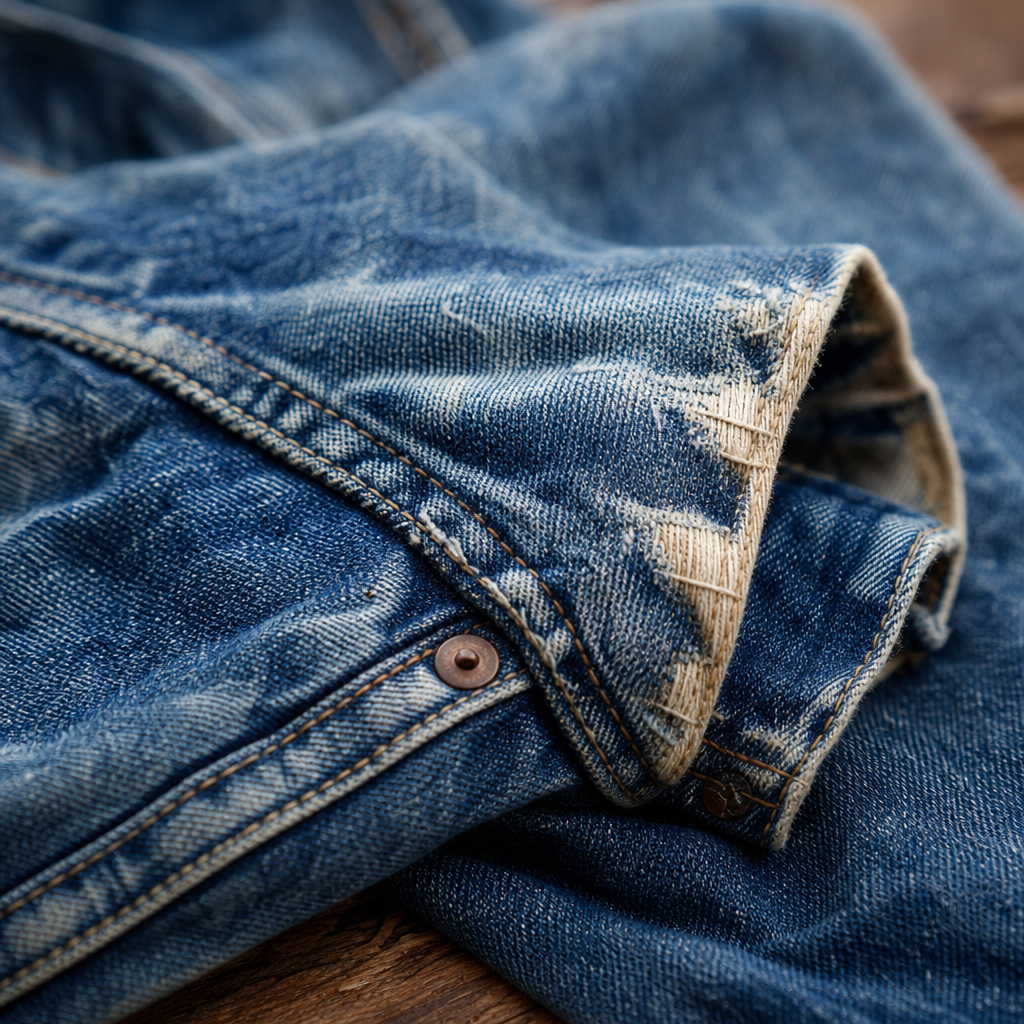
Denim is where this gets genuinely beautiful. That fading that vintage clothing shops charge a premium for? It isn't really fading – it's unravelling. Denim yarn is spun with a twist, and the indigo dye only bonds to the outside of that twist, not the white cotton core underneath. Every time the fabric flexes (which, given that it's wrapped around knees and hips all day, is constantly), the outer fibres abrade slightly against each other and the dye releases. The result is that the whiter a piece of denim gets, the more the twist has literally come undone. You're not buying a faded pair of jeans. You're buying a pair of jeans that have physically unwound.
For fashion and lifestyle content beyond the wardrobe, The Battery Isn't Running Down. It's Growing Old. takes the same idea somewhere completely different.
What causes fabric pilling?
Pilling, which everyone hates and nobody fully understands, is the fabric doing something almost defensive. When short fibres break free from the weave, friction rolls them into those little bobbles you find all over a cheap jumper's armpits after three wears. The pill itself is the broken end of the fibre, bundled up with the broken ends of its neighbours, held together by more friction. You are, in a very literal sense, looking at your jumper's debris. The reason merino wool pills less than acrylic isn't magic – merino fibres are simply longer and take more stress to break free in the first place.
None of this means you should start treating your clothes like museum exhibits. It just means you can read them now. The soft patch on your jacket's elbow is a fatigue map. The fading across the front of your jeans is a record of how you move. Your wardrobe is a slow-motion physics experiment that's been running without you noticing, and it's been trying to show you the results the whole time.
Questions this raises
- Does washing temperature affect garment life?
- How can you make clothes last longer?