

Pick up a £20 note. Look at it properly. It's a rectangle of cotton fibre with some ink on it, and it costs the Royal Mint roughly 9p to produce. And yet if you tried to swap that rectangle for someone's car, or their sofa, or a week of their labour, they'd agree to it immediately without batting an eye. Why would anyone hand over a physical object with real mass and utility, in exchange for a scrap of printed fabric?
Because both of you believe a third thing – a thing that isn't in the room – will honour it. And that third thing is all of us, collectively, holding the same article of faith simultaneously. Like a planet-wide séance where everyone's gripping the table.
What backs the pound today?
This is what money actually is. Not wealth in itself. Not a claim on gold (Britain left the gold standard for good in 1971 – your £20 is backed by precisely nothing material). Money is an agreement. It works the same way a joke lands: only because everyone in the room shares enough context to make it work. Change the room, and the joke dies. Change the agreement, and your £20 note becomes a very expensive bookmark.
The strangest part is that we've always known this, and we've kept going anyway.
When the Agreement Wobbled
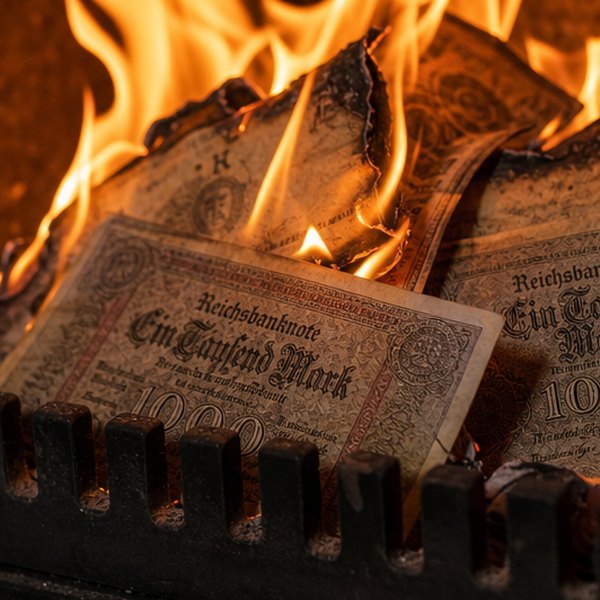
You can find the moments when the agreement wobbled if you know where to look. In Weimar Germany in the early 1920s, people were reportedly lighting fires with banknotes because wood cost less than the paper money required to buy it. The notes were real. The ink was real. But the mutual faith had simply evaporated – and without it, the whole apparatus collapsed so fast it's almost funny, and then immediately isn't. Zimbabwe in the late 2000s reprinted denominations in the hundreds of trillions before giving up and borrowing someone else's currency altogether. Not because the country ran out of resources. The collective hallucination just broke down. If you want to go further into how we sustain that agreement in everyday life and why it matters more than most of us ever stop to think, The Dream We All Agreed to Keep Having is well worth your time.
The Money in Your Account
Here's the version that usually surprises people most: the money in your bank account almost certainly doesn't exist in any physical form. Your bank holds a small fraction of what it owes depositors and lends the rest out, trusting everyone won't ask for it back at once. When they do – when they all ask at once – a bank run happens, and the illusion fails in slow motion.
Which leaves you here, on an ordinary Tuesday, buying a coffee or paying a bill. Every single transaction you make is an act of faith in people you will never meet. The barista trusts the note. The café trusts the bank. The bank trusts the system. You trust all of them without thinking about it, which is probably why it works.
The most extraordinary trick civilisation ever pulled off is that it keeps working at all.
Questions this raises
- What does it cost to produce a banknote?
- Why do we accept money that has no intrinsic value?
- Has money always been a shared fiction?