

Your monitor has never once shown you the colour red. Not a single time. Not even right now, looking at whatever you're looking at. Every red thing you have ever seen on a screen – every warning message, every sunset photograph, every tail-light in a car advert – was a fabrication. A very good one, but still a fabrication. Your eyes have been happily accepting a forgery for decades, and they will never notice.
Here is how the con works.
Three Types of Cone Cell
Inside your eyes are three types of cone cell, the little photoreceptors responsible for colour vision. One type responds mainly to short wavelengths (roughly blue), one to medium (roughly green), and one that you would call the "red" cone. Except the red cone is not really a red cone. It peaks somewhere in the orange-yellow range and only trails off slowly toward genuine red. Crucially, it overlaps quite a lot with the green cone, so the two are not separate instruments picking out separate colours – they are two mics pointing at the same room, one angled slightly differently than the other.
Your brain works out "red" by comparing the signals from both. When the red cone fires strongly and the green cone fires weakly, the brain calls it red. When both fire together at similar levels, the brain calls it yellow. The whole colour wheel you experience is built from a series of these comparisons and inferences. You are not seeing colour. You are being shown the result of a calculation.
How do screens produce colour?
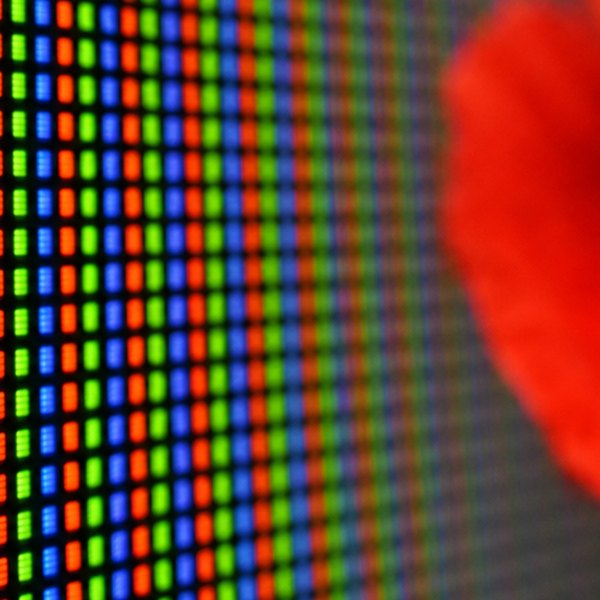
Screen manufacturers figured this out and ran with it. An LCD or OLED panel contains millions of tiny pixel clusters, each holding just three coloured sub-pixels: red, green, and blue. To show you orange, the screen turns up red and adds a bit of green. Yellow gets both sub-pixels fired equally. To show you the rich, deep red of a ripe tomato, it lights up the red sub-pixel and dims the green one just enough that your cone ratio tilts the right way. At no point does the screen produce actual tomato-red light. It produces a combination of signals that triggers the same neural shortcut as tomato-red light would, and your brain does the rest, completely automatically, without ever asking your opinion.
Why Screen Red and Printed Red Differ
This is why "red" on a screen and "red" on a printed page are not really the same thing. Print uses actual red pigment that absorbs other wavelengths and reflects genuine long-wave light back at you. A screen is nudging two cone types into a configuration that your visual system has been trained by evolution to interpret as red. One is a message. The other is an impression of the message.
The same unreliable machinery that your eyes use for colour is also being played with by your memory, which is arguably an even better con artist. The colour you think you loved two years ago and the one you actually chose are likely not quite the same. *The Colour You Think You Chose Two Years Ago* gets into how that happens in some enjoyable detail.
Your eyes have been perfectly content with this arrangement all along. They never asked for the real thing, and honestly, they would not know what to do with it.
Questions this raises
- Why is there no actual red on a display?
- What is additive colour mixing?
- Why do colours differ between screens?