
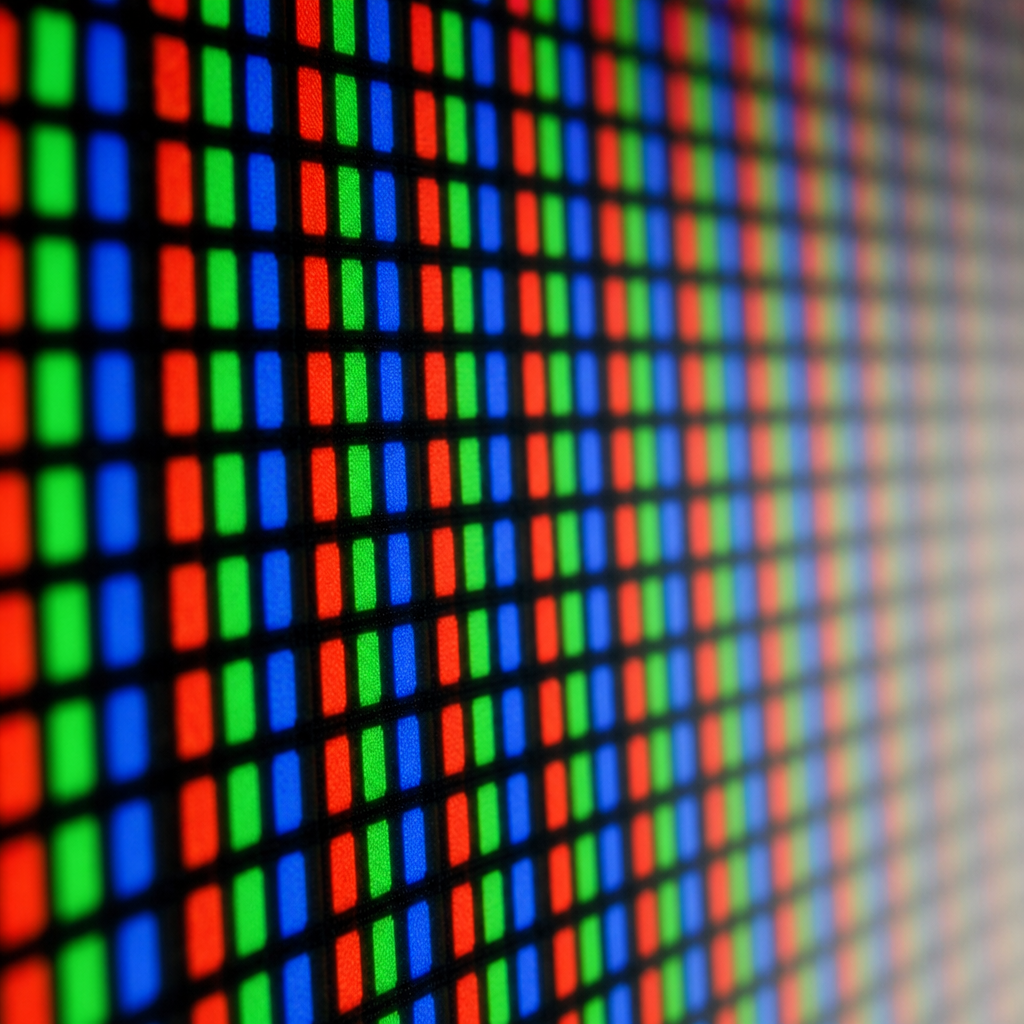
Look at this word: blue. The letters on your screen right now look blue to you. Except there is no blue there. Not a single blue photon is leaving the glass and hitting your eye. What you're actually seeing is a tiny cluster of three microscopic lights – one red, one green, one blue – being asked to perform a conjuring trick on your brain. And your brain, magnificently gullible, falls for it every time.
How does RGB create every colour you see?
Your screen is made of pixels. Each pixel is really just three even smaller lights called subpixels, crammed so close together that your eye cannot resolve them separately. The trick is that your eye has three types of colour-sensing cells – cones – each tuned to respond most strongly to red, green, or blue wavelengths of light. When red and green fire together with no blue, your cone cells report what they would report if you were looking at actual yellow light. There is no yellow light, no yellow anything. Your monitor cannot produce yellow – it is just shouting "red! green!" fast enough that your visual cortex gives up and says, fine, yellow. That yellow is fabricated entirely inside your skull.
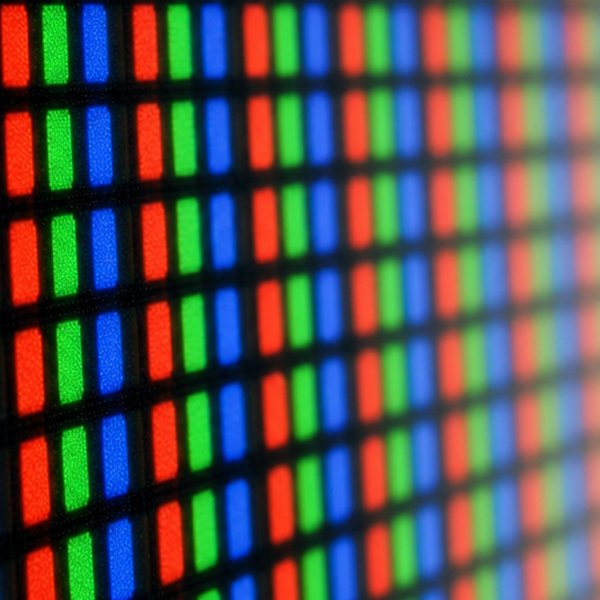
White works the same way. Fire all three at full brightness and your brain, recognising the cone-firing pattern it associates with sunlight, duly informs you that you are looking at white. You are looking at red, green, and blue simultaneously. The experience of white – that sense of no colour at all – is just a story your nervous system tells you to make the maths easier.
What a Medieval Painter Would Say
Medieval painters would have found this philosophically alarming. If you wanted blue in 1400, you needed to actually have blue: specifically, lapis lazuli, a semi-precious stone mined almost exclusively in Afghanistan and worth considerably more than gold by the ounce. The pigment ground from it, ultramarine, had to physically exist in the paint for blue to appear on the altarpiece. A painter who ran out of it simply had no blue – not a cheaper blue, no blue. The colour had to be there, in material form, or it did not exist. For more on that extraordinary corner of colour history, visit The Colour That Cost More Than Gold at https://budgetblog.co.uk/art/the-colour-that-cost-more-than-gold/
Your screen conjures an approximation of that same shade by calculating a ratio: a strong dose of blue subpixel, a smaller splash of green, almost no red. The ultramarine that bankrupted patrons and enriched miners now costs a screen nothing but a few values in a colour profile. The colour was not captured or reproduced. It was reverse-engineered from the inside of your eye.
Can screens show every colour the eye sees?
The strangest part is the colours your screen simply cannot reach. Even with all this trickery, it chokes on vivid oranges, deep saturated cyans, the exact green of fresh grass. A standard monitor cannot fake the cone response those create. They exist in the world, your eye can see them perfectly well, but the red-green-blue recipe has no way to forge the right answer. The con only works within limits. Outside those limits, the screen goes quiet and offers you the nearest thing it can manage, which is never quite the same.
You have never seen the real colour of anything on a screen. You have only ever seen a very confident guess.
Questions this raises
- Why do the same images look different on two monitors?
- What is colour calibration and do you need it?