
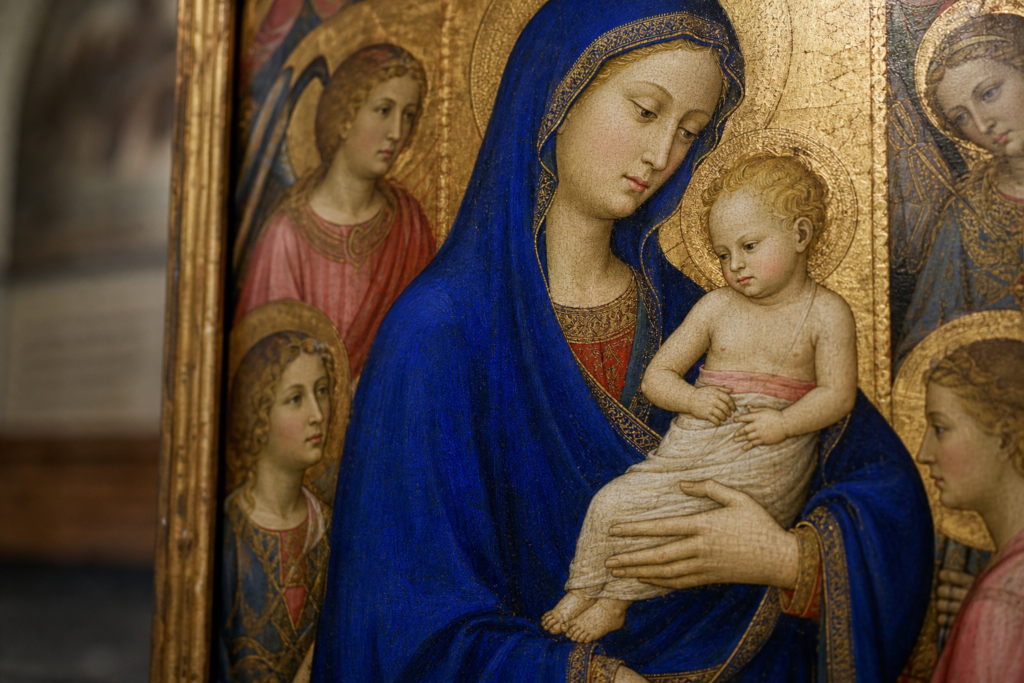
Look at almost any painted altarpiece from medieval or Renaissance Europe and there's a moment where your eye snags on the Virgin's robe. It's that particular deep, almost violent blue – the kind that makes everything else on the panel look slightly apologetic. You probably assume the painter chose it because blue suited the Virgin, because it was beautiful, because it carried some theological weight. And all of that is true. But there's a much more mundane reason that blue is quite so loud, and it has nothing to do with art.
It was a boast. A financial boast, rendered in paint, and it's still sitting there on the wall.
The Contract Came Before the Brush
Before a medieval painter ever picked up a brush, a contract was drawn up. Not a polite letter of intent, not a friendly handshake over supper, but a proper legal document specifying exactly what materials would be used, in what quantities, on which figures. Patrons hired lawyers for this. The contracts survive – historians have found dozens of them – and some are remarkably specific: this much gold leaf for the haloes, this quality of panel, and, above all, this many ounces of ultramarine for the Virgin's cloak, purchased by the patron himself and handed directly to the painter so there was no funny business.
Why was ultramarine so costly in medieval art?
That last part is important. Ultramarine came from lapis lazuli, a semi-precious stone mined almost exclusively in what is now Afghanistan, hauled across trade routes through the Middle East, sold by Venetian merchants at prices that at various points genuinely rivalled gold by weight. A patron who handed over his own ultramarine to the painter was not doing so out of artistic sensitivity – he was doing so because he had paid a fortune for it and did not want it quietly substituted for the considerably cheaper azurite blue, which could look roughly similar until the light hit it and then looked frankly embarrassing.
Why the Virgin’s Robe
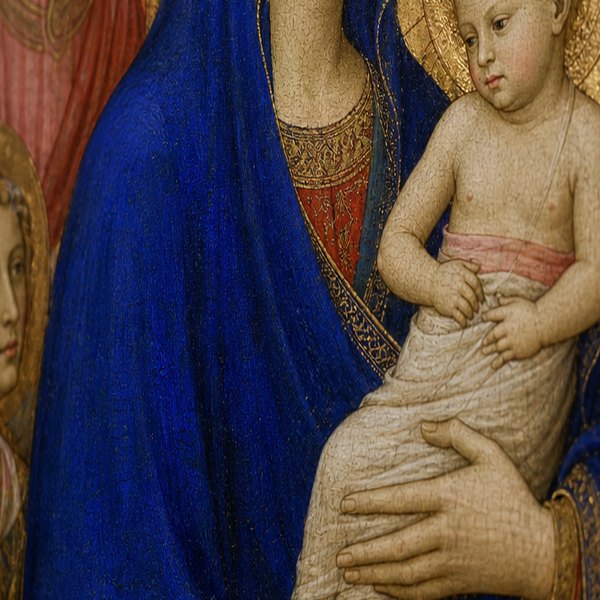
This is why the Virgin's robe became the canonical place for blue. It was the largest single piece of fabric in most religious compositions, which meant it was the largest possible surface area on which to display how much ultramarine you had felt comfortable burning. The more robe, the more blue, the more blue, the more it cost, the more cost, the more everyone who knelt before your altarpiece understood, wordlessly, how seriously you took all of this. The altarpiece was a commission receipt printed in paint and hung where the whole town could see it.
The painter's own ingenuity got squeezed into what was left over. The reds, the ochres, the greens – those were his to interpret, to model beautifully, to carry the light. The blue was more or less accounted for before he started. Some contracts even specified that the painter's own labour was valued separately from the materials, with the materials listed at a higher price than the human being making the thing. Art history tends to focus on genius. The contracts are much more interested in procurement.
You Can Still See It on the Wall
What makes this genuinely strange to sit with is that you can still see it. Next time you're in a gallery in front of a Virgin and Child from the fourteenth or fifteenth century, you're looking at a transaction. The blue isn't just a colour – it's a line item, and the depth and coverage of it is basically a figure on a ledger that never got filed away. Some patrons were lavish and the blue is almost aggressively saturated. Others clearly negotiated, and the robe is a more tentative, thinner application; you can see in places where the ground starts to show through that somebody blinked when the merchant named his price.
The piece that sent me down this particular rabbit hole was an article about how ultramarine came to be worth what it was – the full story of the stone, the trade route, the chemistry: The Colour That Cost More Than Gold.
There's something almost funny about it once you know. All that reverence, all those centuries of kneeling in candlelight before the Virgin's robe – and part of what you were admiring was a successful import negotiation and a canny patron who made sure the painter didn't skimp.
Questions this raises
- How did the cost of blue shape religious painting?
- What replaced ultramarine when it became available?
- Why is the Virgin's robe blue?