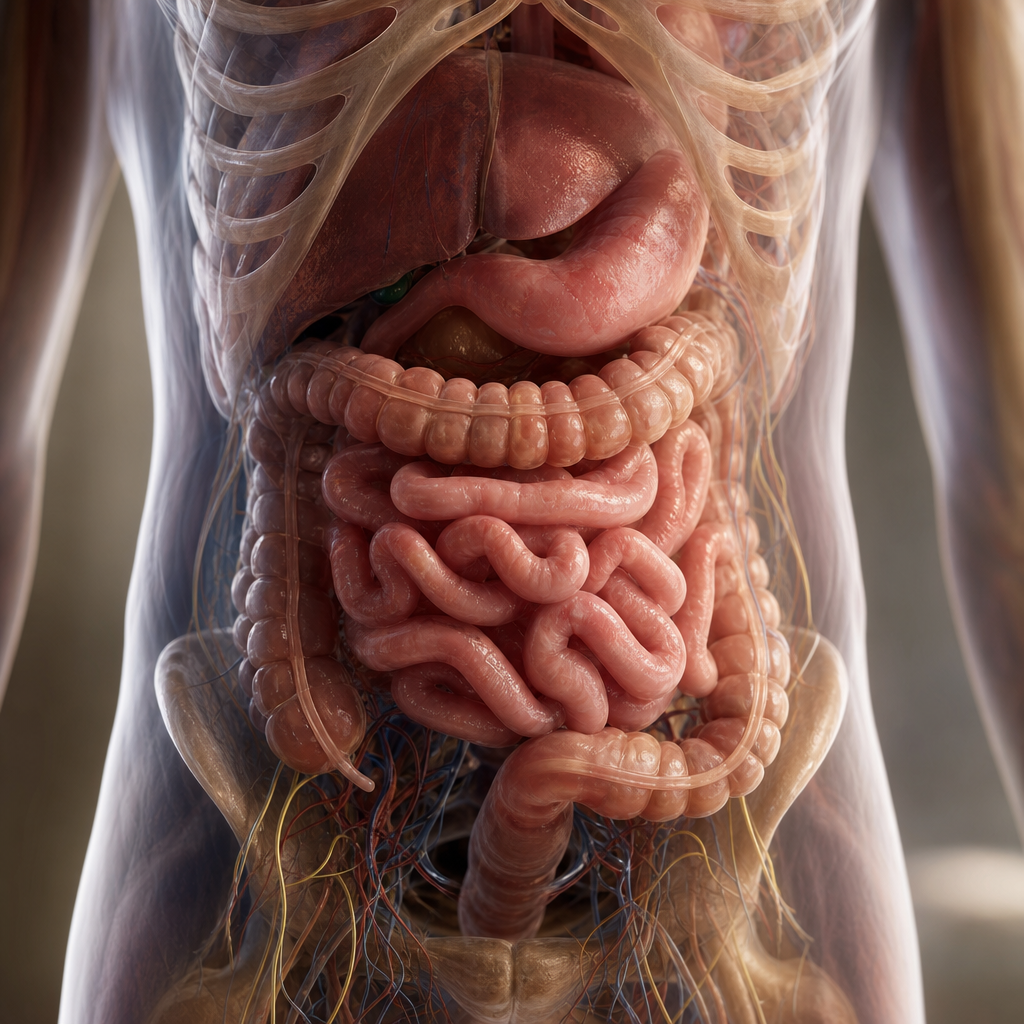

Most of what your body does, you take credit for. You decided to eat lunch. You chose to go for a walk. But there is an entire metropolis inside you that has never once asked your opinion, doesn't particularly care what you think, and was running smoothly long before the bit of you that reads articles like this one had even evolved.
A Full Network of Its Own
Your gut has its own nervous system. Not a relay station, not a branch office – its own full network of roughly 100 million neurons, woven through the lining of your digestive tract from throat to colon. Neuroscientists call it the enteric nervous system, and it is genuinely autonomous in a way that should unsettle you slightly. Cut the vagus nerve – the main cable linking gut to brain – and the gut keeps going. It keeps pushing food through, releasing enzymes, doing its job, because it was never really waiting for instructions in the first place.

It Flips the Top-Down Picture
This matters because it flips the way most people picture the relationship. The assumption is top-down: brain sends orders, body follows. But the enteric nervous system predates the central nervous system evolutionarily. Simple creatures were running a gut-based operation millions of years before anything resembling a brain showed up. Your head, by that reckoning, is the recent addition. The gut is the original management.
Which explains something odd about the vagus nerve, that long wandering cable linking the two systems. Around 90 percent of the signals travelling along it go upwards – gut to brain, not the other way around. The gut is reporting, not receiving. It tells the brain about threats it has detected, about stress it's registering, about whether things seem safe or dangerous. The brain mostly listens, and you experience its verdict as a feeling in your stomach. A hunch. A sudden clench when something seems off – and then probably you ignore it and make a spreadsheet.
Serotonin Is Made Downstairs
The enteric nervous system also produces serotonin, the neurotransmitter that most people associate with the brain. Somewhere in the region of 95 percent of your body's total serotonin is made in the gut. That has obvious implications for mood, for sleep, for how anxious or calm you feel on a given afternoon. It helps explain why so much research into gut bacteria keeps brushing up against mental health, sleep quality, and stress responses. The gut is not just processing your sandwich. It is, in some quite literal sense, running a mood-management operation without telling you. For more on how this two-way conversation shapes the way the brain processes things, see The Brain That Never Got the Memo About Being Second at budgetblog.co.uk.
None of this means you need a new supplement or a complicated elimination diet. It just means the picture is stranger and more interesting than the one you were probably taught – some version of "brain runs everything, stomach digests things". The smarter framing is two old collaborators who've been working together for a very long time, where one of them does considerably more of the actual work and just quietly lets the other one think it's in charge.
Questions this raises
- What bodily processes run without conscious control?
- How much energy does the body use at rest?
- What is the autonomic nervous system?
- Can you influence automatic processes?